




Register company in Poland – which legal form of business activity should you choose?
Choosing the right legal form is one of the most important decisions when you register a company in Poland. The structure you choose affects not only how the business is managed, but also the scope of liability, taxation, accounting obligations, corporate governance and future growth options. For foreign entrepreneurs in particular, this decision should be made with a clear view of both the Polish legal framework and the practical realities of running a business in Poland.
There is no single structure that fits every business model. A consultant starting a small service business will usually need a different setup than founders planning a scalable venture, a holding structure or cooperation with investors. For that reason, it is worth assessing not only the ease of registration, but also liability exposure, bookkeeping requirements and long-term expansion plans before deciding how to register a company in Poland.
What legal forms of business activity can you choose from in Poland?
In Poland, business activity can be conducted either as an individual entrepreneur or through a company structure. In practice, the most common options are:
- sole proprietorship (JDG) – the simplest form for individuals operating on their own;
- civil partnership – a practical option for two or more partners cooperating in a relatively simple business model;
- partnerships – including a general partnership, professional partnership, limited partnership and limited joint-stock partnership;
- capital companies – including a limited liability company, a simple joint-stock company (PSA) and a joint-stock company.
It is also important to distinguish between Central Registration and Information on Business (CEIDG) and National Court Register (KRS). A sole proprietorship is registered in CEIDG, while commercial companies and partnerships are entered into KRS. This affects both the registration process and the company’s ongoing formal obligations.
Foreign nationals can also register a company in Poland, but the available options depend on citizenship and, in some cases, on the legal basis of stay and residence in Poland. In general, EU and EEA nationals enjoy broad access to business activity in Poland, while third-country nationals may be subject to additional conditions depending on whether they intend to run a sole proprietorship or establish a company. In practice, capital companies are often the most straightforward choice for foreign investors.
Register company in Poland – quick comparison of the most common legal forms
| Legal form | Registration | Liability | Level of formalities | Typical use case |
|---|---|---|---|---|
| Sole proprietorship (JDG) | CEIDG | Full personal liability | Low | Freelancers, consultants, small service businesses |
| Civil partnership | Partners in CEIDG + tax/registry formalities for the partnership | Joint and several liability of partners | Low to medium | Small businesses run jointly |
| General partnership | KRS | Partners liable for partnership obligations | Medium | Joint business without share capital |
| Professional partnership | KRS | More limited liability in relation to professional errors of other partners | Medium | Regulated professions |
| Limited partnership | KRS | General partner – broad liability; limited partner – limited liability | Medium to high | Different roles for managing and investing partners |
| Limited liability company (sp. z o.o./LLC) | KRS | As a rule, shareholders’ risk is limited | High | Growth businesses, foreign investors, risk limitation |
| Simple joint-stock company (PSA) | KRS | As a rule, shareholders’ risk is limited | High | Start-ups, innovative ventures, investor-ready structures |
| Joint-stock company (S.A.) | KRS | As a rule, shareholders’ risk is limited | Very high | Large-scale ventures, capital raising |
| Limited joint-stock partnership | KRS | General partner liable; shareholders generally not liable for company debts | Very high | Advanced ownership structures |
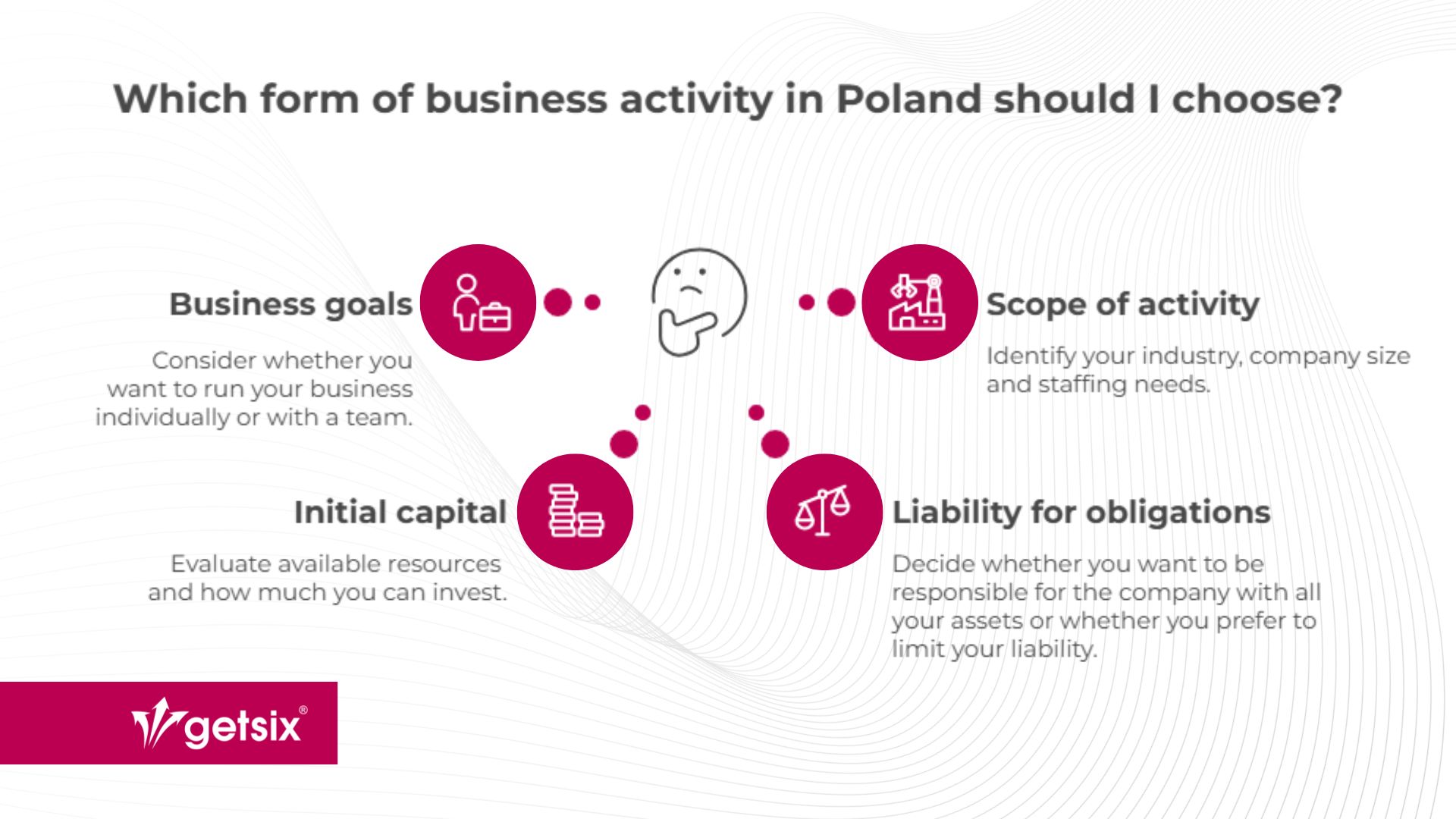
What should you consider before choosing a legal form in Poland?
Before you register a company in Poland, it is worth assessing several practical issues:
- Will you run the business alone or with partners?
This often determines whether a sole proprietorship is sufficient or whether a company structure is needed from the outset. - How much business risk will the company take on?
The greater the contractual, operational or financial risk, the more relevant liability protection becomes. - What are your growth plans?
If you are planning to hire employees, bring in investors or sell shares in the future, a company structure is often more suitable. - Which tax model is likely to be efficient?
The legal form affects the available tax framework and the accounting burden. - How much administration are you prepared to handle?
Some forms are simple to start but less efficient at a later growth stage. Others require more formalities but offer stronger protection and better corporate order. - Will banks, investors or international counterparties assess your structure?
For many foreign-owned businesses, legal form influences credibility and ease of cooperation in the Polish market.
If accounting obligations are part of your decision-making process, it is also worth considering whether the chosen structure will require full accounting in Poland or whether a simpler bookkeeping model may be available at the outset.
Legal forms of business activity in Poland – advantages and limitations
1. Sole proprietorship (JDG)
A sole proprietorship is the simplest way to start a business in Poland. It is registered in CEIDG and the entrepreneur acts in their own name. This is a common option for consultants, self-employed professionals and small service providers.
Who is it recommended for?
- individuals starting a business on their own;
- freelancers, consultants and specialists working independently;
- small businesses looking for a fast launch and low administrative burden.
Advantages:
- simple and fast registration – the CEIDG process is straightforward and can be completed online;
- tax flexibility – depending on the case, different taxation methods may be available;
- low level of formalities – especially at the start of the business;
- full control – decisions are made directly by the entrepreneur without corporate procedures.
Limitations:
- full personal liability – this is the main legal and financial risk of this structure;
- no clear separation of personal and business assets;
- limited suitability for scaling – especially where investors, partners or more complex ownership structures are involved.
2. Civil partnership
A civil partnership is not a separate legal entity in the same sense as a commercial company. It is based on an agreement between partners, while the partners themselves remain the entrepreneurs. This distinction is important from both a legal and practical perspective.
Who is it recommended for?
- two or more individuals who want to run a relatively simple business together;
- partners looking for a low-threshold structure with flexible internal arrangements.
Advantages:
- simple structure based on a partnership agreement;
- no minimum share capital;
- flexibility in shaping internal cooperation rules.
Limitations:
- joint and several liability of the partners for obligations connected with the business;
- less suitable for larger or more formal business operations;
- less practical in investor or financing contexts.
3. General partnership
A general partnership is one of the basic partnership forms under Polish commercial law. It conducts business under its own business name and can acquire rights and incur obligations in its own name. For many founders, it is a more structured alternative to a civil partnership, but it still does not offer the liability shield associated with a limited liability company.
Who is it recommended for?
- partners planning to run a business together without establishing a capital company;
- businesses that want a more formal commercial-law structure but do not require a share-capital model.
Advantages:
- more structured form than a civil partnership;
- no minimum share capital;
- flexibility in regulating relations between partners.
Limitations:
- partner liability remains a material business risk;
- less protection of private assets than in capital companies;
- requires careful tax and operational analysis before use in a larger business model.
4. Professional partnership
A professional partnership is designed for individuals performing specific regulated professions. One of its key features is that, as a rule, a partner is not liable for the consequences of professional services provided by other partners or by persons subordinated to them.
Who is it recommended for?
- doctors, lawyers, architects, auditors and other regulated professionals;
- partners who want to cooperate within a commercial-law structure while limiting exposure to the professional mistakes of other partners.
Advantages:
- a more favourable liability model in relation to the work of other partners;
- no minimum share capital;
- clear structure for cooperation between professionals.
Limitations:
- available only for specific professions;
- less universal than a limited liability company;
- requires well-designed governance and representation rules.
5. Limited partnership
A limited partnership is useful where the founders want to differentiate roles and liability levels. It includes at least one general partner and at least one limited partner.
Who is it recommended for?
- business partners who want to separate management and investment functions;
- projects in which one party runs the business and another wants a more limited risk profile.
Advantages:
- clear division of roles between different categories of partners;
- greater flexibility in ownership and operational design than in simpler partnership structures;
- useful for more sophisticated business arrangements.
Limitations:
- the general partner bears broad liability for the partnership’s obligations;
- more formalities than in a sole proprietorship or civil partnership;
- tax and accounting treatment is more demanding and should be assessed in advance.
6. Limited liability company (LLC / sp. z o.o.)
The limited liability company remains one of the most frequently chosen forms for foreign investors and growing businesses in Poland. It is often the natural choice where separation between private assets and business risk is important.
Who is it recommended for?
- entrepreneurs planning to scale, hire employees and enter into larger contracts;
- founders who want a clearer ownership structure;
- businesses working with investors, banks or international counterparties.
Advantages:
- limited shareholder liability as a rule;
- stronger market credibility than a sole proprietorship in many business contexts;
- clear ownership structure and easier onboarding of additional shareholders;
- good platform for growth and organised corporate governance.
Limitations:
- higher level of formalities both at incorporation and during ongoing operations;
- mandatory full accounting;
- greater corporate administration, including resolutions and internal governance documentation;
- management board responsibility must be taken seriously in certain situations under Polish law.
If you are considering this structure, you may also want to read: Register company in Poland – Limited liability company (LLC).
7. Simple joint-stock company (PSA)
The simple joint-stock company is a relatively modern form that remains highly relevant in 2026, especially for innovative businesses and founder-investor structures. It combines selected features of capital companies with greater organisational flexibility than a traditional joint-stock company.
Who is it recommended for?
- start-ups and technology-driven companies;
- projects preparing for investment rounds;
- founders who want a more flexible approach to governance and equity structuring.
Advantages:
- very low capital threshold at incorporation;
- greater flexibility than a traditional joint-stock company;
- attractive structure for high-growth projects, including ventures expecting external investors.
Limitations:
- it is still a capital company, so it requires a well-organised legal and accounting setup;
- it is not necessary for every business model;
- its benefits are best used when the corporate documentation is carefully designed.
8. Joint-stock company (S.A.)
A joint-stock company is designed mainly for larger ventures requiring a formal corporate structure and broader capital-raising possibilities. For most entrepreneurs starting out in Poland, it is a specialist rather than a default option.
Who is it recommended for?
- larger enterprises and capital groups;
- businesses planning substantial external financing;
- projects requiring a full corporate governance framework.
Advantages:
- strong market credibility;
- broad capital-raising options;
- appropriate structure for large-scale and complex ventures.
Limitations:
- very high level of formalities;
- costly legal and organisational maintenance;
- usually excessive for small and medium-sized businesses at the incorporation stage.
9. Limited joint-stock partnership
A limited joint-stock partnership is typically used in more advanced ownership structures. It combines elements of a partnership and a joint-stock company, but it requires a much higher degree of legal and tax awareness than the more common options.
Who is it recommended for?
- businesses with more sophisticated ownership and control arrangements;
- entrepreneurs and investors deliberately building a layered structure of management and capital participation.
Advantages:
- possibility to separate managerial and capital functions;
- useful for specialised corporate structures.
Limitations:
- complex legal framework;
- high compliance and maintenance costs;
- rarely the right first choice for a standard new business.
Sole proprietorship, LLC or simple joint-stock company – which option is most practical in Poland?
In practice, most entrepreneurs who want to register a company in Poland compare three main options first: a sole proprietorship, a limited liability company and a simple joint-stock company.
- A sole proprietorship is often sufficient where the business model is simple, risk is low and there is no need for partners or investors.
- A limited liability company is usually more suitable where liability protection, credibility and room for structured growth are priorities.
- A simple joint-stock company is worth considering where the business is designed from the start with investors, flexible equity arrangements or fast growth in mind.
For this reason, these three forms are often the most realistic starting point in 2026. Other structures are usually chosen when they reflect a specific professional, ownership or tax need.
Can non-registered activity replace formal company registration?
At an early stage, some entrepreneurs also look at non-registered activity. However, this is not the same as formally registering a business in Poland. It may be useful for testing a very small-scale concept, but it is not a substitute for a proper business structure where the activity is intended to be ongoing, scalable or professionally organised.
If you plan to work with B2B clients, hire staff, build a recognisable brand, enter contracts on a regular basis or expand in Poland, formal company registration remains the proper route.
Summary – how to choose the right legal form when you register a company in Poland
The right legal form should be chosen based on your business model, level of risk and growth plans, not only on how easy the registration looks at the start. For some entrepreneurs, the simplicity of a sole proprietorship will be enough. For others, the stronger liability protection of an LLC or the flexibility of a simple joint-stock company (PSA) will be far more appropriate.
If you plan to register a company in Poland for a business that is expected to grow, cooperate with investors, expand internationally or operate within a clear ownership structure, the legal form should ideally be selected after reviewing the tax, accounting and organisational consequences in advance.
If you need support with company registration in Poland, choosing the right legal structure or organising accounting support in Poland, getsix® can help you prepare a solution aligned with the scale and profile of your business. Contact us.
If you have any questions regarding this topic or if you are in need for any additional information – please do not hesitate to contact us:
CUSTOMER RELATIONSHIPS DEPARTMENT

ELŻBIETA NARON
Head of Customer Relationships
Department / Senior Manager
getsix® Group


***


